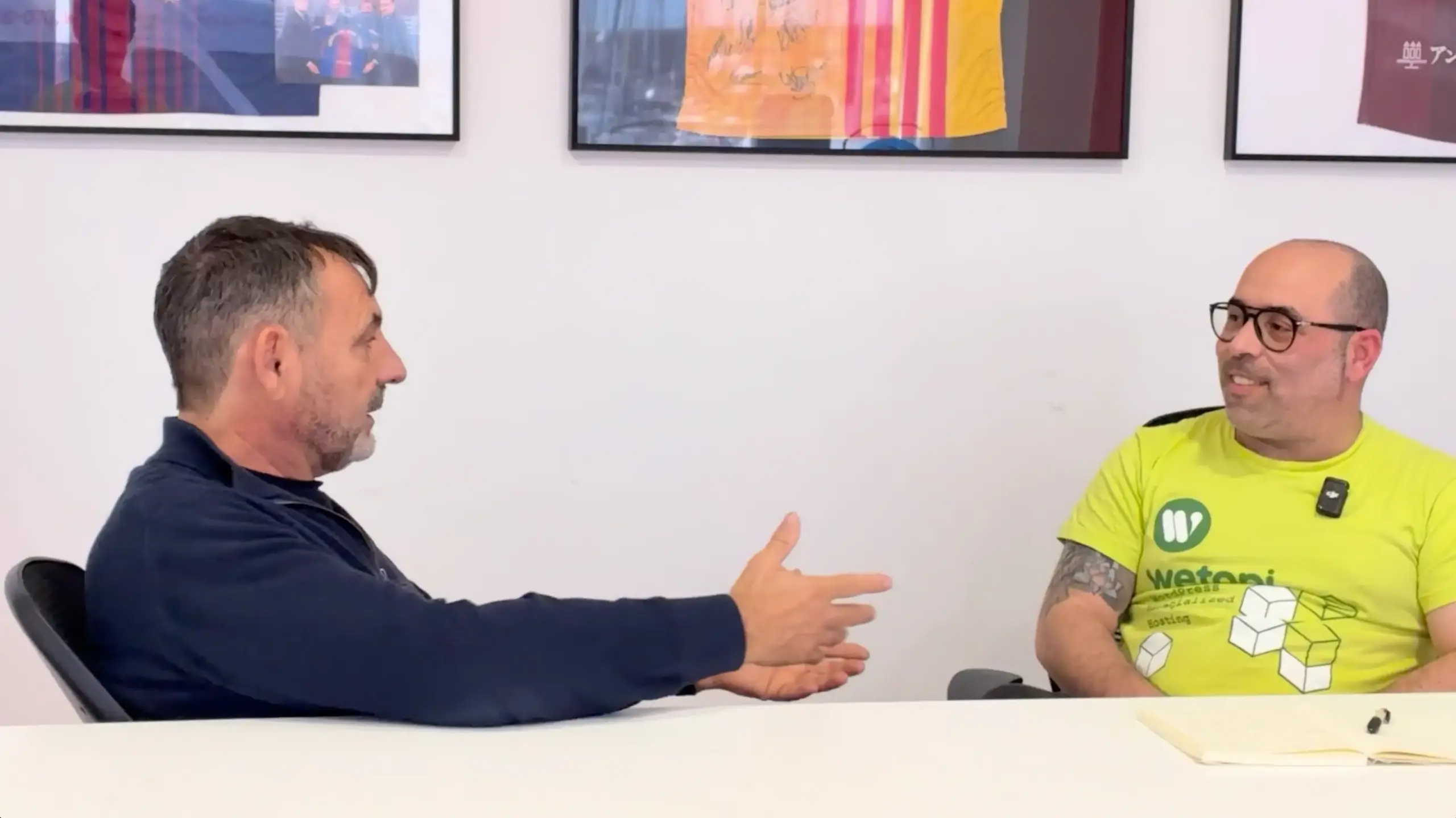
Part of the Wetopi team visited Òscar Camps, founder and director of Open Arms, to talk about rescues, human rights, disinformation, and the power civil society has when it gets off the couch. And Wetopi got off the couch a long time ago.
The question that keeps coming up… and the one that’s really missing
The conversation starts where it almost never does: by asking about the questions nobody asks, or which one he’d most like to answer.
“When I give a talk or get interviewed, I ask for more participation from people.”
Òscar Camps, founder of Open Arms
And Òscar answers: the most common one is “how did it all begin,” but he quickly shifts the focus to remind us that, when he’s interviewed, he’d like more participation from people.
At Wetopi we like to explain everything clearly, and one of our principles is that we don’t have any fine print. That’s why we don’t talk about an interview, but about a conversation, with questions and doubts that have fully verifiable answers.
I’m a lifeguard, not an activist
“I’m a lifeguard, not an activist. My job is to pull people out of the sea and save lives. I’m not the one saying it, international conventions and maritime law say it. I’m just doing my job.”
Òscar Camps, founder of Open Arms
A doctor who saves lives isn’t an activist, he’s a doctor. A lifeguard who pulls people out of the sea isn’t doing politics, he’s doing his job: saving lives.
Òscar explains it with disarming clarity: lifeguards don’t ask where you’re from, they ask if you’re breathing. If you’re not, they start CPR. They don’t ask for a passport before performing resuscitation. Administrative status, origin, skin color, or religion are secondary when a life is at risk. And he isn’t the one saying this, international conventions and maritime law say it.
The question he asks himself, and would like everyone to ask, is a different one: who do you have to ask for permission to save a life?
A mission against the current
That’s the title of the book Open Arms recently published, which Òscar describes as a book with an A-side, a B-side, and a backbone.
The A-side gathers all the good things that have been said about the project. The B-side, the criticism, the attacks, the disinformation. But what really matters, he says, is what’s in between: the backbone. And that backbone is people. The volunteers, the human team, everyone who made this possible.
“I’d like the backbone in a future book to grow so much that the A and B sides stop being relevant. That the story left behind is the one of so many people who mobilized, who got off the couch.”
Òscar Camps, founder of Open Arms
More than 73,000 lives… and why a single story can weigh more
We put a striking figure on the table: more than 73,000 lives saved. And we also raised a reflection. What weighs more, the total, or not having made it in time in a single case?
The answer was direct.
The 73,000 is a figure counted by the communications team. Those on the boat don’t carry numbers, they carry memories. Memories of people, of situations, of emotions.
“The ones that weigh the most aren’t the successful rescues, but the ones where they didn’t make it in time. A single one of those weighs more than all 73,000 combined.”
Òscar Camps, founder of Open Arms
Because they aren’t numbers in a spreadsheet. They’re people with parents, children, dreams, and a life that was left behind in the sea.
Social media: a pit of artificial hate and the question he’s never asked
There’s a moment in the interview that hits especially hard. Òscar explains that on the street, people recognize him, congratulate him, hug him.
But when he opens social media, he runs into a pit of hate that feels like another world.
And the question he’s rarely asked comes up, tying back to the beginning of this conversation.
“I wish they’d ask me what I think about social media and how I can live with these bot farms, funded by specific interests, and fake journalists who get paid to write every day against Open Arms and against me personally.”
Òscar Camps, founder of Open Arms
He defines it as a pit of artificial hate, and they shout loudly because there are few of them. They need to make noise because the majority, the ones who think differently, are quiet. They don’t take a public stance, they don’t reply, they don’t click like, but they’re there. And it’s a lot more people than it seems.
We share principles and haters
When we asked Camps about public corporate support, he framed it realistically: there are companies that back them visibly and others that do so quietly. Wetopi puts its public support on the table, and Camps responds with a sentence that sums it up well: “We’ll share haters. Wetopi’s response was: We don’t care.”
He doesn’t say it to trivialize the hate, but to keep it from becoming a criterion. He acknowledges there may be money invested in tearing down digital reputations, but he insists that shouldn’t condition what’s right.
At Wetopi, we take it in stride.
We publish our principles because we commit to them, not because they look good on a website. Working with Open Arms isn’t a reputational “extra”: it’s the logical consequence of believing that transparency, honesty, and responsibility matter, even when it’s uncomfortable.
History doesn’t judge you for what you think, but for what you do
The closing of the conversation leaves a sentence that serves as a yardstick for everything that’s been said: what remains isn’t what you declare, but what you do.
“hope my granddaughter will one day be able to say she was proud of her grandfather.”
Òscar Camps, founder of Open Arms
Open Arms defines its mission as “defending human rights and saving lives at sea.” At Wetopi, we define ours as working with transparency, honesty, and responsibility. The common ground is clear: always putting principles and people first.
